Living the Fiction

Early morning on the middle reaches of the Huon River: treed banks fading into mist; dark, fast-flowing water

Writing fiction is wonderful for mapping the contours of your ignorance.

I like to give my fictional people a solid footing in reality: a place, a profession, a relatable problem they’re trying and/or failing to deal with. After all, I enjoy reading fiction that informs as well as entertains, and I try to write fiction that I would enjoy to read.

Our real world is interesting enough for me: I don’t need to build new ones.

So I need realistic detail in the things that my characters do, both for a living and to find personal fulfilment. By inclination and for practical reasons, I tend to pick activities I have first-hand knowledge of.

Thus sourdough-baking, banjo-playing, bee-keeping, scythe-mowing, German-speaking, sailing sculptors are probably over-represented in my work, compared to the demographic mean.

Even so, I rarely get half a page written without needing to check facts.

We have such wonderful research tools these days, but sometimes Wikipedia plus YouTube videos, Facebook groups, obscure member forums and how-to websites just aren’t enough. Neither are books — and good grief I have some obscure titles on my bookshelves. Archaeology of the Chinese Fishing Industry in Colonial Victoria, anyone?

Go see!

Secondary sources are great — but sooner or later, you need to go see for yourself. Be in the place. Talk face-to-face with people who do the thing you’re writing about.

My two current stories on Substack — they will make up the two halves of a novel — are set in Tasmania.

For those unfamiliar with my country, that’s the Ireland-sized island to the south of the mainland. Mountainous, forested, swept by the Roaring Forties. With a population less than Dublin City, or the Wichita metro area. To get there from my home in coastal Victoria, you need to cross 250 miles of often stormy sea.

Audrey Liza concerns a man, a mine electrician, who has bought an old wooden fishing boat sight-unseen on the internet, untroubled by the fact that he has no seafaring experience. Specifically, he has bought a crayboat, a ‘cray’ or ‘crayfish’ being to an Aussie what the rest of the English-speaking world calls a ‘rock lobster’.

The Last Orchard concerns a woman, an environmental scientist, who has inherited an inaccessible and unprofitable orchard from her uncle. For reasons which will emerge as the story unfolds, he was the family’s black sheep.

Both stories have as their motive force the sort of existential crisis that tends to grip people towards the end of their career. Life choices get re-evaluated; sometimes, crazy decisions get made.

Research vacation

So of course, my wife and I went to Tasmania.

It was a month-long vacation in our little Toyota Hiace campervan, combined with research. The research objects were an unlikely combination on the face of it: crayboats and cider apples.

Many of our trips since I started writing fiction have had a research element. It’s fun!

Instead of your itinerary being determined by a gushy guidebook, well-meant but one-eyed personal recommendations (‘You really must see … ’) or general curiosity, it’s mapped to places and events that might turn out relevant to the sketchy story in your head.

Serendipity strikes

Then — pow! zap! — serendipity strikes.

You go for a wander round a quiet harbour while your spouse explores the secondhand bookshop. You spot an interesting-looking boat. Ooh! That looks rather like a crayboat, but with a full sailing rig. Let’s take a closer look. Here’s a little sign in the rigging — with a potted history of the boat and the phone number of the owner. You drop him a text message and within an hour you’ve arranged with the owner’s brother to take a look over the boat. It becomes a model for the one in your story.

Now things start to get weird. The brother has the same first name as the protagonist of your other story. And he’s a leading apple grower, or was before he retired. What the … ?!

It starts to dawn on you: all the ways — the complex and surprising ways — that your seemingly random subjects, apples and crayboats, are connected.

Momentum builds. By breakfast time the next day, you have the personal number of the leading cider maker in Tasmania. You suppress your impostor syndrome and give him a call. You make a date for later in the month.

He’s as good as his word. On the appointed day, he takes you for a whirlwind tour of his orchards, taking two hours out of his busy working day, right in the middle of co-ordinating picking crews — it’s autumn and the apple harvest is in full swing.

Weft and warp

And so on and so forth. You meet another cider maker and orchardist. She takes time out to show you what an old, neglected orchard would look like — the sort you need for your story. What happens to apple trees when they’re not tended and pruned.

You stay in a beach house on the most astonishingly beautiful beach. In days and nights filled with the crashing surf, you dream a childhood for your protagonist there — in an imaginary fishing community. Two months later, you will discover by chance that the fishing village once existed.

You get to sail on a 70-year-old crayboat. The stand-in helmsman has renovated his own crayboat, promises to send you details. He’s as good as his word, too. You take a tour of the Wooden Boat School in Franklin, where students learn the boatbuilding skills your protagonist is going to need. You buy more obscure books about Huon pine — the remarkable timber from which ‘your’ boat is built. You stay on a property which with just a little imagination resembles the Last Orchard, albeit sans apple trees. 

The dense weft and warp of right times, right people, right places starts to tighten into a fabric which will form the backdrop to your story.

You drink a lot of cider. For research purposes.

You sit outside a cottage in the Huon Valley as the mist forms thick as cotton wool over the inky river, and the logging trucks rumble by, changing down through their gears to climb the hill behind you.

It starts to feel real. Like your characters exist, and the things you imagine really happened.

From then on, it’s not so much making-shit-up as interrogating the minds of your characters, to find out what they did and why.

So yeah, fiction research and vacations. They go together like crayboats and apples.

Thanks for reading!
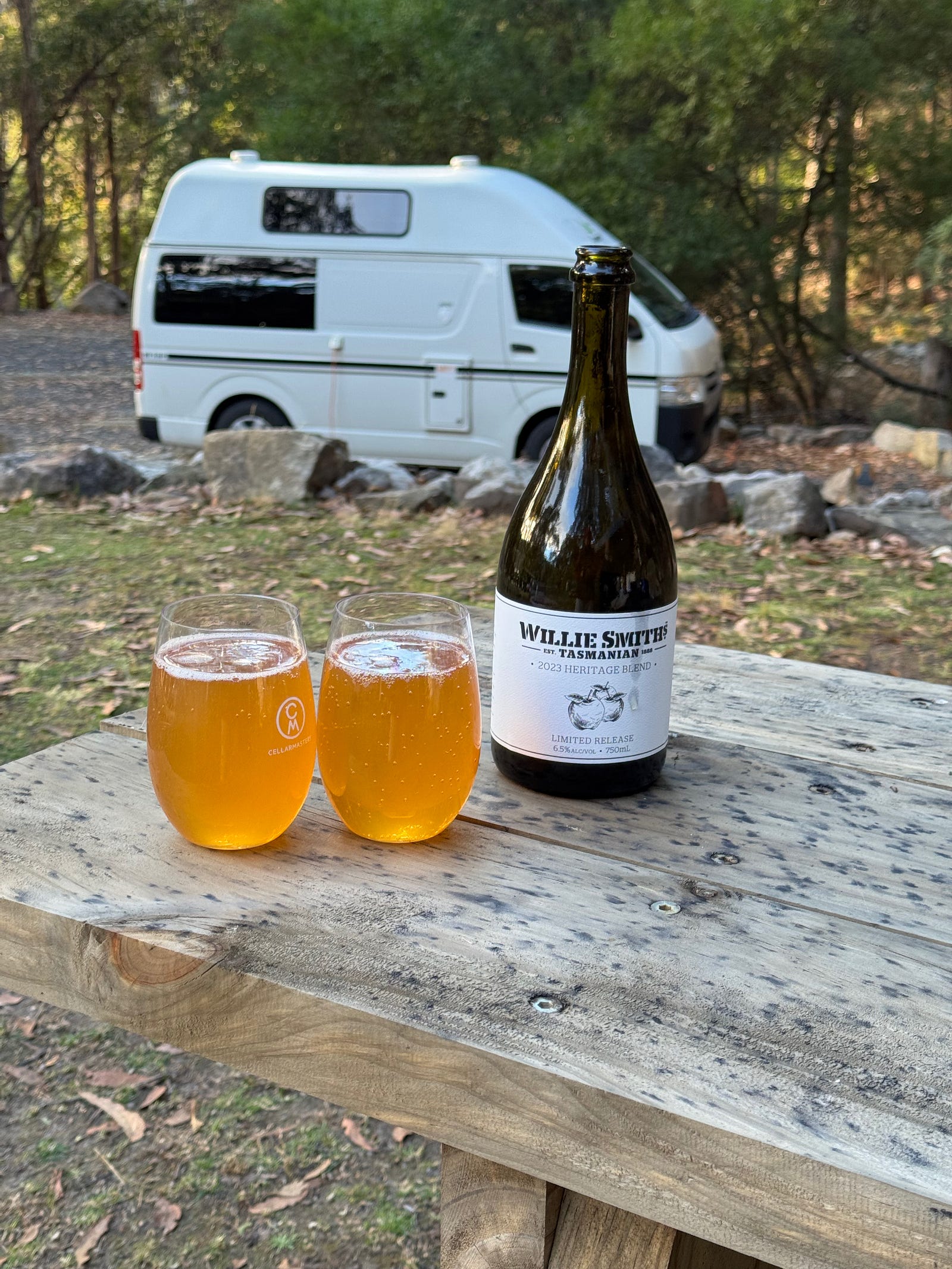
‘Research in Progress’ by the author

For Art’s Sake!

Thoughts about illustrating my stories

One of the many things that two years’ writing on Medium and Substack has gifted me as a writer is a delight in illustrating my stories.

My main interest is adult fiction (interspersed with quasi-factual meanderings like this one). In this field, the word is deemed sufficient. Illustrated stories are for kids — or for magazines. That’s the received wisdom, whether or not we choose to thumb our noses at it.

A lot of it was once simple economics, not any superiority of the printed word over the printed image. Until quite recently, illustrations used to be prohibitively costly to integrate with text. ‘Plates’ were literally etched plates. Full colour required four separate plates, four passes through the printing press, four times the expense of black-and-white. Even black-and-white photos needed to be printed on expensive coated paper and bound in discrete sections (signatures) of the book.

Digital printing technology has freed a lot of that up, but illustrations still add to cost, and fiction readers expect cheap books. Hardly any of the hundreds of novels on my shelves have illustrations integrated with the text.

So — publishing illustrated stories on Medium and Substack is a unique opportunity that I make the most of … in the certain knowledge that none of my illustrations will make it into the print editions I have planned for the last quarter of this year.

Continue reading “For Art’s Sake!”

Against the Wind

An author’s lament

I enjoy the promotional aspect of writing, mostly. Whether it’s scheduling newsletters for my Substack, updating my website and blog or making little videos for Tiktok, I experiment boldly and gladly. I accept defeat philosophically, dust myself off and try something else.

Sometimes, though, the sheer unrelenting effort of getting folk to clap eyes on my stories gets me down.

Today is one of those days.

Many people who read this will be in that same crowded little boat. In online writers’ groups, whether on Medium, in Twitter’s writing community, on Substack or on Booktok, we’re mostly promoting our writing to a supportive but time-poor crew of fellow writers. Each with a long To Be Read list already.

Out there, somewhere, amorphous and shifting like fog on the horizon, is the Greater Reading Public. It seems a wide gulf between us.

Continue reading “Against the Wind”

It’s a Jungle Out There


Finding my way in the thicket of advice for new fiction authors

There’s no shortage of advice online for fiction writers. Indeed, rather the opposite.

I see novice writers on Twitter obsessing over whether they are telling when they should, in fact, be #showing? What about adverbs: are we allowed adverbs? How many per paragraph? Does my inciting incident have to come before page 10? Is my writing sufficiently inclusive — but not culturally appropriative? What’s my genre? How many comps do I need for a synopsis? Sex in YA fiction: yes or no? Is 250K words too many for a first novel? Can I write it in the second person, future perfect tense?

There’s nothing wrong with this seeking and proffering of advice. The problem lies in the corollary: sifting, evaluation, often rejection.

Any piece of advice offered to a writer needs to be viewed suspiciously from all angles like an apple in the supermarket. Unlike with the apple, the writer can — must — take a bite, give it a good chew before maybe spitting it out on the figurative floor of the metaphorical Fresh Produce Department. Without the cashier calling Security to deal with a disturbance in Aisle Two.

Continue reading “It’s a Jungle Out There”

The Kick Inside


A male writer’s fascination with female perspectives

Fiction writing is — in equal parts — imagination, empathy and transmogrification of lived experience.

The alchemy which turns my leaden autobiography into fictional gold (hopefully) is often a change of viewpoint. It’s the ‘What if?’ which sparks the narrative from the inciting incident.

Very often, I find myself wanting to write fiction from a female perspective. I’ve been told, by female readers whose opinion I value, that I’m good at it. About seventy per cent of my regular readers are female, so I guess I can’t be too lousy.

That’s gratifying praise, but I would be sad if it were unusual. Why should biological sex be a barrier to empathy or imagination? A man who cannot step outside his own ego to consider what a woman might desire in a lover, what she might hope for or fear in life, her insecurities, passions and preoccupations, is a sad specimen of humanity.

We consider it unremarkable that a female author might write a male protagonist well. The converse should also apply. It’s not as if there’s a shortage of study material, in terms of literature by female writers, and — shock! horror! — real live women to converse with.

A teen obsession

One of the great passions of my teenage years — that turbulent time of consuming and confusing passions — was the music of Kate Bush.

Continue reading “The Kick Inside”

In search of … what, exactly?

Why do we tell the stories that we tell?

On the occasion of my wife’s birthday, we’re in Melbourne for the week. For the first time since COVID hit our shores, we find ourselves in the CBD with time on our hands.

Suze likes to spend hours poking around markets; I’d sooner stick wasps up my arse, frankly. Luckily, we’re accustomed to giving each other space to do our own thing, rather than approaching every outing as a joint activity.

Fear not: we also have a shared calendar of events with multiple highlights and points of interest and time spent with friends – those who haven’t contracted COVID in the last couple of days. I’m not leaving the poor woman entirely to her own devices on the august occasion of reaching three-score years and ten.

So anyway, this morning, Suze was buying music-themed socks at the Vicky Market (hey, it’s her birthday) and trying to work out the location and name of that pub she went to with the girls that one time that sells Belgian cherry beer: an absorbing task for a woman with scant sense of direction and a love of Kriek.

Continue reading “In search of … what, exactly?”

Treading Carefully

Reflections on a first attempt at writing a historical novel

‘The past is a foreign country; they do things differently there.’ 

L. P. Hartley, The Go-Between, 1953

Out of my comfort zone

I grew up an Englishman on English soil. The past of the land I lived on was my past; I felt, rightly or wrongly, that I understood it intimately, intuitively.

These days, I live on the other side of the world, in a country where, until 1788, there were no Englishmen, other than a tiny number of whalers and sealers at a few points around our continent’s vast coastline — and no Englishwomen at all, as far as is known.

Stolen land, stolen history

The ‘settlement’ of the land that I live on, here in Victoria, began in 1835 with the landing of John Batman and his party.

It’s so close that I feel I can almost reach out and touch it. There are still descendents of the first settlers living on the same land their ancestors took possession of. Let’s not mince words: the land that they stole, with the connivance of the British Crown.

Continue reading “Treading Carefully”

Telling Tall Tales … and Tiny Ones

Launching a Substack storyletter — progress and plans

I decided towards the end of last year that I was going to launch a fiction newsletter on the Substack platform. Tall and Tiny Tales went live on 1 February.

Substack seems to be rather the flavour of the month, although evaluations differ, and some, if I may say so, miss the point entirely. Substack isn’t really a community like Medium. It’s primarily a publishing platform. Your potential readership isn’t other Substackers: it’s anyone who likes to read your genre online. (Truly: forget about other Substackers. Stats on them are irrelevant.) The snag is: you have to do all the publicity for your publication yourself. No friendly algorithms are going to carry your word to the masses.

Continue reading “Telling Tall Tales … and Tiny Ones”

‘Just Say a Few Words’

Reflecting on public foot-in-mouth experiences.

When I was young and silly, I had an absolute terror of making a fool of myself in public. Like most of us, I got over this by doing it repeatedly.

Mostly, I didn’t jump — I was pushed.

Piss-poor in Wigan

Six months into my first job as an editor, my friend and colleague Stefan saddled me with giving a talk on ‘Trading with Germany’ to the worthy members of the Wigan & District Chamber of Commerce.

He’d given one a few months previously and they’d asked him back, but he was coming down with a cold. As he was German, this required languishing at home for a week, being pampered by his lovely Dutch girlfriend.

I had neither a cold nor a lovely Dutch girlfriend, and I was the company’s other ‘German expert’.

‘It’s easy, Steve, you just stand there and talk a bit, then answer questions. They’re very friendly.’

Yeah, right.

Continue reading “‘Just Say a Few Words’”